
Myth-Busted: Do More LEDs Mean a Brighter Street Light? Understanding Lumens, Efficacy, and Brightness
- coco wang
- 2025年8月29日
- 讀畢需時 10 分鐘


Introduction: A "Seeing is Believing" Procurement Trap
In the process of procuring solar street lights, a very common and seemingly intuitive belief is: "the more LED chips on the light head, the brighter the light must be." When you open samples from two suppliers and see one fixture packed with 200 LEDs versus another with only 50, your immediate instinct might be to assume the former is of better value and more "substantial."
This method of "counting the chips" is a dangerous oversimplification. It is a "seeing is believing" trap that is more than capable of sinking your project investment. It stems from a fundamental misunderstanding of LED lighting technology and is often exploited by manufacturers looking to cut costs on core components while creating a facade of value.
In reality, the true "brightness" and long-term performance of a street light have no necessary positive correlation with the number of LED chips. Often, the relationship is inverse. The real keys to performance are the critical metrics hidden deep within the technical data sheet: Luminous Flux (Lumens) and Luminous Efficacy (lm/W). This article will thoroughly debunk this widespread myth and help you build a scientific evaluation framework to ensure every light you procure is a genuinely high-performance piece of equipment.
1. The Core Concepts: Redefining the Language of "Bright"
To be a professional buyer, we must first unify our language and use scientific metrics to measure "brightness," not guesswork or visual intuition. This is akin to evaluating a computer by its CPU benchmark scores, not by the number of fans in its case.

1.1 Chip Count vs. Luminous Flux (Lumens): The Unit vs. The Total Output
This is the most critical and easily confused distinction.
LED Chip Count: This is merely a physical tally of the number of individual light-emitting diode units in the fixture. By itself, it describes no aspect of performance. A perfect analogy: a choir of 100 whispering schoolchildren will be far less audible than a single, professionally trained opera singer. Here, the number of people (chip count) does not equal the volume (brightness). A high chip count simply means the manufacturer has chosen a "quantity-over-quality" technological path, and behind that quantity often lies a compromise in quality.
Luminous Flux (Unit: Lumen, lm): This is the only scientific unit for measuring the total amount of visible light emitted by a source in all directions. It is an absolute performance metric. The higher the lumen value, the more total light energy the source radiates, which is what we colloquially mean by "brighter." Whether a light uses 50 or 200 LEDs, what ultimately determines its brightness is its total lumen output. For any buyer, luminous flux is the first and most fundamental anchor point for evaluating brightness.
1.2 Wattage vs. Luminous Efficacy: Energy Consumption vs. Conversion Efficiency
Another common mistake is clinging to the old incandescent-era belief that "higher wattage means brighter." In the age of LEDs, this logic is completely obsolete.
Wattage (Unit: Watt, W): In LED lighting, a watt measures the rate of energy consumption. For a grid-powered street light, it determines your electricity bill. For an off-grid solar street light, it is a critical cost unit, as it directly dictates how large and expensive your solar panel and battery need to be to "feed" it.
Luminous Efficacy (Unit: lm/W): This is the "litmus test" of an LED's technological advancement. It is the bridge connecting "brightness" to "cost" and is the core metric for assessing a lighting product's technical sophistication. It is defined as: how many lumens of light are produced for every 1 watt of electricity consumed. The higher the efficacy, the more efficiently electrical energy is converted into light, and the more advanced the technology.
A Realistic Business Scenario & Quantitative Comparison:Imagine a municipal project that requires street lights to deliver 6,000 lumens of luminous flux.
Solution A (Low Efficacy): A supplier offers a 50W street light using standard technology with an efficacy of 120 lm/W.
50W * 120 lm/W = 6,000 lm (Meets the brightness requirement)
Solution B (High Efficacy): Another supplier offers a mere 35W street light, but it uses top-tier LED chips and driver technology, boasting a high efficacy of 171 lm/W.
35W * 171 lm/W ≈ 6,000 lm (Also meets the brightness requirement)
Decision Analysis:Both lights produce the exact same amount of brightness (total lumens), but Solution B's energy consumption is a full 30% lower than Solution A's. For a solar lighting project manager, choosing Solution B means they can specify a 30% smaller solar panel and a 30% smaller battery for the entire system. This will dramatically reduce the project's initial Total Cost of Ownership (TCO) and result in a lighter, easier-to-install system.
2. The "More Chips" Trap: Why Quantity Misleads Decisions
Now that we know quantity doesn't equal brightness and that efficacy is key, why does the market still feature so many products that use a "human wave" strategy? The answer lies in a deep trade-off between cost, quality, and long-term project risk.
2.1 The "Human Wave" Tactic of Low-Quality Chips & the Illusion of Cost
As a technology-intensive product, an LED chip's brightness and efficiency are directly linked to its size, manufacturing process (MOCVD), and materials (sapphire substrate, phosphor formula). High-quality, high-power LED chips from top-tier brands (e.g., Cree, Lumileds) are expensive but deliver exceptional lumens and efficacy from a single source. In contrast, low-power, small-size chips from lesser-known factories are extremely cheap but have poor efficacy, reliability, and color consistency.
Therefore, to win in fierce price wars, some manufacturers employ a classic "race to the bottom" strategy: they use a large quantity of cheap, inefficient, low-power chips and simply stack them to achieve a "total lumen" figure that looks decent on paper. Buyers who only count the chips are fooled by this illusion of "substance," believing they've secured a high-value product when, in reality, they've purchased a bundle of underperforming electronic components with a short lifespan.
2.2 The Thermal Disaster & The "Death Spiral" of Lumen Depreciation
This "human wave" strategy creates a fatal and nearly unsolvable engineering problem: a thermal disaster.
Concentration of Heat: Hundreds of small chips soldered densely onto a limited-size aluminum PCB create a massive, uniform "heating blanket." Each chip is a heat source, and with no clear path to escape, the temperature of the entire board skyrockets.
Uncontrolled Lumen Depreciation: LEDs are extremely sensitive to high temperatures. For every 10°C rise in the PN junction temperature, an LED's lifespan is roughly cut in half. A "multi-chip" street light with poor thermal design forces the LEDs to operate in a constant state of "high fever." This accelerates the aging of the internal packaging materials and phosphor, causing a rapid decline in light output, known as "lumen depreciation." Such a light can lose over 30% of its initial brightness in as little as 6 months, entering an irreversible "death spiral."
High Risk of the "Purple Light" Phenomenon: The constant baking at high temperatures is also the primary catalyst for the delamination of the phosphor coating from the blue die, which is the root cause of the infamous "purple street light" defect.
In contrast, a design using a few high-quality, high-power chips has a more concentrated and manageable heat source. Engineers can design a highly targeted and efficient thermal management system (e.g., using heat pipes or a large die-cast aluminum heat sink) to rapidly conduct heat away from the chips. This ensures they operate at a safe temperature for the long term, guaranteeing an extremely low rate of lumen depreciation and a lifespan of over 100,000 hours.
2.3 The Systemic "Penalty": A Burden on the Solar Panel and Battery
For a savvy solar lighting system integrator or project owner, choosing a low-efficacy luminaire creates a domino effect that impacts the entire system, leading to runaway total project costs and long-term risks.Using our earlier example to achieve 6,000 lumens, Solution A (low efficacy) requires a 50W light, while Solution B (high efficacy) needs only a 35W light.To ensure the light stays on for the same duration at night and has the same weather autonomy (e.g., 3 rainy days), the system using Solution A must:
Be equipped with a larger solar panel: To generate the extra electricity, an additional (50-35)W = 15W of panel capacity is needed. This not only increases the direct procurement cost but also increases the wind load area, demanding a stronger, more expensive pole.
Be equipped with a larger battery: To store the extra energy for 3 days of backup, the battery capacity must be increased by 15W 10h/day 3 days = 450Wh.The solar panel and battery typically account for over 50% of the total cost of a solar street light system. Therefore, a low-efficacy light head that seems a few dozen dollars cheaper will ultimately "penalize" you by forcing you to spend several hundred dollars more on the two most expensive components. It is a classic case of being "penny wise and pound foolish."
3. The Smart Buyer's Guide: From "Feeling" to "Data-Driven" Procurement
As a professional B2B buyer—whether you are a Project Manager, a Government Procurement Officer, or a Technical Engineer—you can take control. By implementing a systematic process of data acquisition and analysis, you can easily cut through the marketing fog and identify a product's true performance value.
3.1 Step One: Baseline Filtering – Lock on "Total Luminaire Lumens" & "Luminaire Efficacy"
This is the first "filter" in your procurement process, designed to quickly weed out underperforming, entry-level products. Your core task is to request and scrutinize the official Technical Data Sheet (TDS) provided by the supplier.
Checkpoint 1: Total Luminaire Lumens / Lumen Output
What to do: Find this line item in the TDS. This is the baseline for the fixture's total light-emitting capability.
Pitfall to Avoid: Be wary of suppliers who use "Theoretical LED Source Lumens" to confuse buyers. The raw lumen output of the LED chips will suffer losses of 10-20% after accounting for the driver efficiency and optical losses from the lens. You must insist on seeing the fully tested "Total Luminaire" lumen output. A professional manufacturer will clearly specify this and may even provide a third-party lab test report (like an IES LM-79 report) as proof.
Checkpoint 2: Calculate and Compare "Luminaire Efficacy"
What to do: This is the "silver bullet" for identifying superior technology. Take the "Total Luminaire Lumens" and divide it by the "Total System Power Consumption."
Formula: Luminaire Efficacy (lm/W) = Total Luminaire Lumens (lm) / System Power (W)
The Professional Benchmark:
< 130 lm/W: Outdated or entry-level technology. Should be immediately disqualified.
130 - 160 lm/W: Competitive, mainstream market level.
> 160 lm/W: High-end or top-tier product, representing leading technology and a lower total system cost.
What this means for different roles:
For the General Contractor: Higher efficacy means achieving the same brightness with a lower-wattage light. This allows for smaller solar panels and batteries, leading to a more price-competitive overall bid.
For the Facility Manager: Higher efficacy means lower energy consumption. For a solar system, this translates to longer autonomy during cloudy weather and a longer battery lifespan, directly reducing future maintenance risks.
3.2 Step Two: Scene Matching – Verify the Value of "Effective Light"
Having high lumens and high efficacy only completes the "light generation" step. The more critical step is how this light is "used" efficiently. A top-tier professional buyer will focus on how the light is precisely distributed onto the required surface.
Checkpoint 3: Request and Interpret the IES Photometric File
What to do: An IES file is the "optical fingerprint" of a luminaire, containing data on its 3D light distribution pattern. All serious lighting manufacturers must provide IES files for their products.
Why it's important: Different roads have different needs. A two-lane road requires a long, rectangular "batwing" distribution (like IES Type II), while an intersection needs a broader, squarer distribution (like IES Type V). Choosing the wrong distribution, no matter how bright the light, results in wasted light (spilling onto green belts or into residents' windows) and insufficient illumination on the road (creating dangerous "zebra stripe" dark spots).
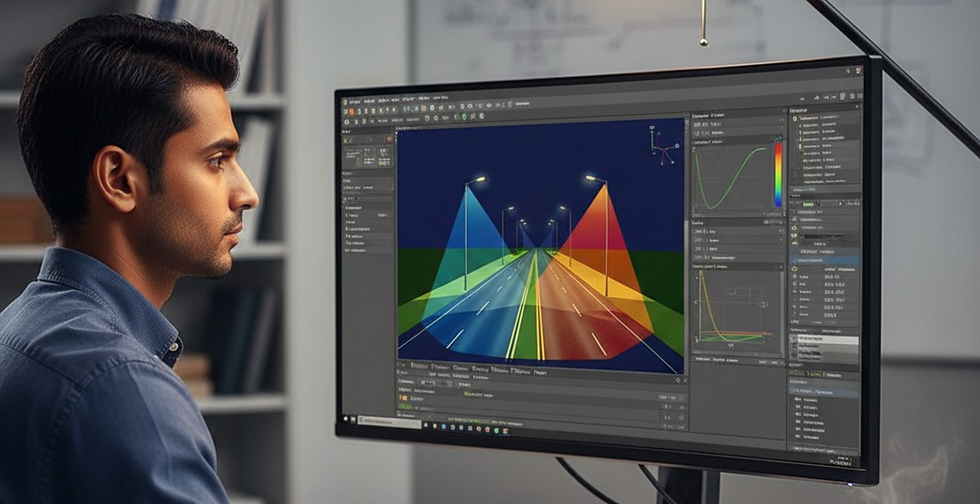
Checkpoint 4: Demand a DIALux Lighting Simulation Service
What to do: This is the most scientific way to translate paper specs into visual results. Provide the supplier with your project's core parameters:
Road type and width
Pole height, spacing, and arm length
Your required lighting standard (e.g., IESNA RP-8 or European EN 13201)
Evaluate the Simulation Report: A professional DIALux report will use false-color maps and data tables to show you precisely what you'll get on your road surface:
Average Illuminance (Eav): Determines the overall brightness level of the road.
Overall Uniformity (U0): Determines if the light is spread smoothly, critical for avoiding the "zebra effect."
Other Key Metrics: Such as Threshold Increment TI (glare control).Upgrading Your Decision: At this stage, your decision-making basis has evolved from "How bright is this light?" to "Can this light, in my specific project, meet my required professional lighting standards in the most efficient way possible?"
3.3 Step Three: Long-Term Thinking – Assess the Durability of "Brightness"
You are not buying the "momentary brilliance" of day one; you are investing in the sustained lighting performance over the next 5-10 years.
Checkpoint 5: Scrutinize LM-80 and TM-21 Reports
LM-80 Report: This is a long-term aging test report for the LED package itself, typically providing 6,000-10,000 hours of test data. It tells you the intrinsic decay rate of the chip.
TM-21 Report: This is a projection, based on LM-80 data, that mathematically calculates the LED's long-term lifespan (e.g., L70, the time until brightness drops to 70% of initial) at a specific operating temperature inside a real luminaire.
The Professional Requirement: Demand the LM-80 report for the LED source used and the corresponding TM-21 projection for the complete luminaire. An L70 lifetime of over 100,000 hours is the hallmark of a truly industrial-grade product.
Checkpoint 6: Examine the Thermal Management & Warranty Details
Physical Inspection: Examine the luminaire's heat sink. Is it a solid piece of ADC12 die-cast aluminum? Do the fins have sufficient surface area and clear airflow channels? Does it have a substantial weight? These physical attributes are a direct reflection of thermal performance.
Warranty Clauses: A reliable warranty must include a performance guarantee. Look for brands that are confident enough to make specific commitments to "lumen maintenance" within the warranty period (e.g., "warrants lumen maintenance of ≥85% over 5 years"). This is far more valuable than a generic "5-year warranty" statement.
Conclusion: The Cognitive Leap from "Counting Chips" to "Reading Data"
The myth that "more LED chips mean a brighter street light" is a relic of an early industrial mindset focused on "piling on materials." In today's era, driven by technological efficiency, this notion is thoroughly obsolete.
True value lies not in how many LEDs you use, but in how you use the least amount of energy to produce the most efficient, precise, and durable light. To make this shift, you need to complete three key cognitive upgrades:
From looking at Quantity to looking at Lumens: Focus on total light output, not the number of physical units.
From looking at Watts to looking at Efficacy: Focus on energy conversion efficiency—this is the core of the technology.
From looking at the "Lamp" to looking at the "Road": Focus on the final, effective illumination result, as this is the fundamental goal of the project.
When you begin to speak this scientific, data-driven language with your suppliers, you will arm yourself with the "X-ray vision" needed to discern quality from mediocrity. You will be able to easily select lighting products for your projects that are truly efficient, reliable, and possess exceptional long-term value.
Are You Still Puzzled About How to Evaluate a Street Light's True Brightness?
Investing in superficial "quantity" is a poor substitute for investing in intrinsic "efficiency."
Contact the expert team at Novafuture Tech (nfsolar) for an in-depth project consultation or product inquiry. We are committed to providing complete technical data sheets and IES files for every product. We are eager to assist you in analyzing key data like efficacy and lumens, helping you make the wisest investment decision in a transparent and professional manner.
Website: www.nfsolar.net
Email: cocowang@novafuture.net
WhatsApp: +8613013537907


留言